
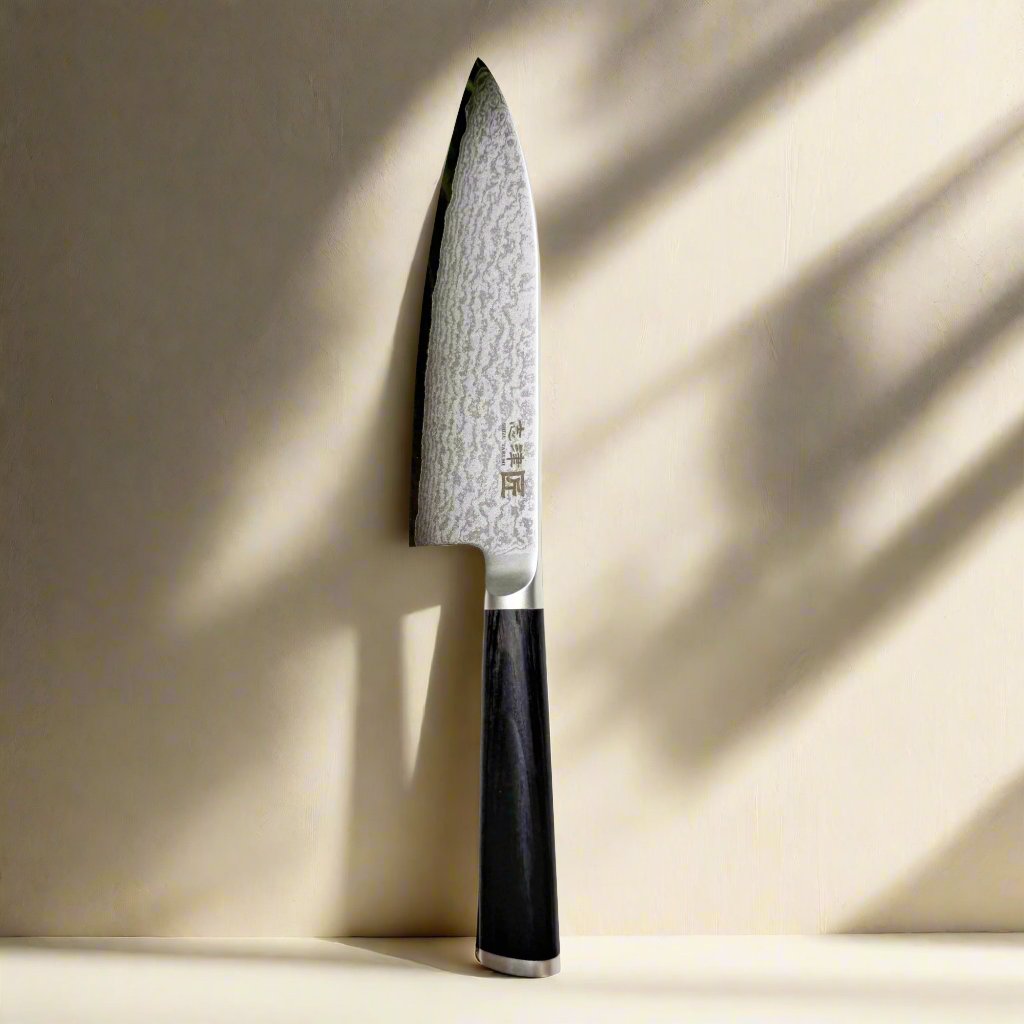
Le couteau japonais Deba : un indispensable pour la préparation du poisson et de la viande
Le couteau japonais Deba — deba-bōchō — est l'une des plus anciennes lames spécialisées de la tradition culinaire japonaise. Épais au dos mais affûté comme un rasoir, il a été développé par les poissonniers d'Osaka pour préparer le poisson entier avec un seul outil polyvalent. Aujourd'hui, il reste la référence en matière de préparation du poisson, aussi à l'aise dans les cuisines étoilées au Michelin que chez les cuisiniers amateurs bien équipés qui attachent de l'importance à un travail bien fait.

Le nom deba (出刃) se traduit approximativement par "lame en saillie" — une référence au profil distinctif du couteau : épais au dos, s'effilant abruptement vers un tranchant aiguisé à biseau unique. Contrairement aux couteaux de chef occidentaux aiguisés symétriquement sur les deux faces, le dos plat et le biseau creux du Deba signifient que chaque mouvement se déplace parallèlement à la planche à découper, réduisant la traînée et produisant des filets immaculés.
Au cours de siècles de raffinement dans les districts de forge de couteaux de Sakai et Seki, le Deba est passé d'un outil purement utilitaire pour le poisson à une lame prisée des collectionneurs et des professionnels — un couteau qui récompense une technique habile et qui, grâce à un entretien soigneux, dure toute une vie.
Aiguisé sur une seule face, produisant une géométrie asymétrique qui réduit la résistance à la coupe et permet au couteau de suivre le contour naturel du squelette du poisson.
Le dos prononcé concentre la masse au talon, donnant au Deba l'autorité de couper de petits os et cartilages sans endommager le tranchant.
Les Deba traditionnels sont forgés à partir d'acier à haute teneur en carbone ou d'acier Hagane, atteignant une dureté Rockwell supérieure à 60 HRC pour une rétention de tranchant exceptionnelle et un affûtage sans effort sur une pierre à aiguiser.
Le manche wa octogonal ou en forme de D — généralement en magnolia ou en bois de ho — est léger, adhère bien même mouillé et équilibre parfaitement le poids vers l'avant de la lame.
-
一
Découper un Poisson Entier Coupez la tête derrière la nageoire pectorale, puis passez la lame le long de la colonne vertébrale en longs mouvements de traction. Le dos plat glisse sur l'arête ; le tranchant sépare la chair proprement sans la déchirer.
-
二
Couper à travers les Petits Os Utilisez le talon lourd de la lame et un mouvement de hachage ferme et contrôlé vers le bas. La masse du dos fait le travail — ne forcez jamais ou ne tordez jamais à travers l'os, ce qui risquerait d'ébrécher le tranchant.
-
三
Filetage de Précision Pour les coupes de qualité sashimi, le dos plat du Deba maintient la tranche parallèle à la planche. Tirez le couteau vers vous en longs passages, laissant l'angle aigu du biseau produire des surfaces lisses comme un miroir.
-
四
Volaille & Viande Légère Les grands Deba (180–210 mm) découpent facilement le poulet et les côtes de porc, ce qui en fait un deuxième couteau polyvalent pour les cuisiniers qui préfèrent un mode de travail à la japonaise.
Les couteaux Deba sont dimensionnés en fonction du poisson à préparer. Une bonne règle : la longueur de la lame doit être environ ½ à ⅔ de la longueur du poisson. Pour les cuisiniers amateurs, un Deba de 150 mm gère 90 % des tâches quotidiennes ; les professionnels travaillant avec de grands bars ou vivaneaux optent pour 180–210 mm.
| Taille | Idéal pour | À qui il convient |
|---|---|---|
| 105–120mm | Truite, maquereau, sardines | Cuisiniers amateurs, petites cuisines |
| 150mm | Dorade, portions de saumon | Choix polyvalent au quotidien |
| 165–180mm | Saumon entier, bar | Cuisiniers amateurs sérieux, clubs de cuisine |
| 195–210mm | Thon, grande sériole, poisson de Méditerranée | Chefs de poisson professionnels |

L'acier à haute teneur en carbone conserve un tranchant extraordinaire, mais il exige un entretien attentif. Quelques minutes après chaque utilisation suffisent pour préserver une lame qui durera plus longtemps que n'importe quel couteau de cuisine en acier inoxydable.
Des lames compactes de 150 mm pour un usage domestique aux couteaux professionnels de 210 mm, notre collection Deba sélectionnée s'étend de l'acier au carbone forgé à la main traditionnel aux hybrides modernes en acier inoxydable — tous expédiés du Japon.

Ecrit par Online Support


Laisser un commentaire
Ce site est protégé par hCaptcha, et la Politique de confidentialité et les Conditions de service de hCaptcha s’appliquent.