
How to Care for a Wooden Cutting Board: Oiling, Waxing and Everything In Between
A good cutting board is one of the hardest-working tools in your kitchen. Treated well, a solid wood cutting board can last decades — even a lifetime. Neglected, it can warp, crack, harbour bacteria, and fall apart within months. This guide covers everything you need to know to keep your board clean, conditioned, and safe for years to come.
Before diving into care, it's important to understand that different types of cutting boards require different levels of maintenance. The more natural the material, the more attention it needs — and the more rewarding the results.
Single-piece hardwood boards (maple, walnut, cherry, teak). Beautiful and durable, but highly sensitive to moisture and drying. Requires regular oiling, waxing, and careful washing.
Made from smaller pieces of wood glued together. More dimensionally stable than solid boards — less prone to warping — but still require regular oiling and correct washing habits.
HDPE or polyethylene boards. Dishwasher safe, non-porous, and highly resistant to moisture damage. Require minimal conditioning but should be replaced when deeply scored.
A solid wood board cut from a single plank is the most demanding of the three. Because it is one continuous piece of timber, it absorbs and releases moisture in one direction — making it far more susceptible to warping and cracking if not cared for correctly on both sides equally.
This is the single most important rule of wooden cutting board care. The dishwasher will destroy a wooden cutting board — without exception.
Dishwashers expose wood to prolonged hot water, steam, and high-heat drying cycles. This combination causes the wood fibres to expand and contract rapidly and unevenly, leading to warping, cracking, and splitting. The high alkaline detergents strip away any protective oil finish.
Synthetic (plastic) boards marked as dishwasher-safe are the only cutting boards suitable for machine washing.
Correct washing technique makes a significant difference to the long-term health of your board. The key principles are speed, temperature, and dryness.

Always wash wooden boards with cool or lukewarm water. Hot water causes wood fibres to swell and open the grain, increasing moisture absorption and accelerating warping.
A small amount of mild dish soap is perfectly safe for wooden cutting boards if rinsed off promptly. Wash, rinse immediately, and dry.
Never submerge a wooden board in water or leave it sitting in a sink of water. Prolonged soaking saturates the wood deeply, causing severe warping and swelling.
After washing, pat both sides dry immediately with a clean cloth or paper towel. Then stand the board upright on its side to allow air to circulate freely on both faces.
Solid wood boards are especially vulnerable to differential drying. If one face dries faster than the other, the board will cup toward the wetter side. Never lay a wet board flat on a countertop.
Oiling is the most important ongoing maintenance step for any wooden cutting board. Oil prevents the wood from drying out, keeps it from absorbing water too readily, and stops it from cracking and splitting.
- Food-grade mineral oil (best choice)
- Food-grade camellia oil (stable, odourless)
- Pure tung oil (fully cured)
- Board cream / wood butter
- Fractionated coconut oil (stable form)
- Walnut oil (if no nut allergies)
- Olive oil — goes rancid
- Vegetable oil — goes rancid
- Sunflower oil — goes rancid
- Canola oil — goes rancid
- Any cooking oil not listed above
Oils that are not shelf-stable will turn rancid inside the wood, causing an unpleasant odour and potentially contaminating food. Always use food-grade mineral oil or a purpose-made board oil.
1. Make sure the board is completely clean and dry before oiling.
2. Warm the mineral oil very slightly — warm oil penetrates the wood more deeply.
3. Apply a generous amount to all surfaces — both faces, all four edges, and the underside.
4. Leave to absorb for a minimum of 4–6 hours, or ideally overnight.
5. Wipe off any excess oil that has not been absorbed.
6. Repeat 2–3 times for the best result, especially on a new board.
Solid wood boards require oiling on all six surfaces including the underside. Oiling only the top face causes moisture imbalance and warping. Always treat every surface equally.
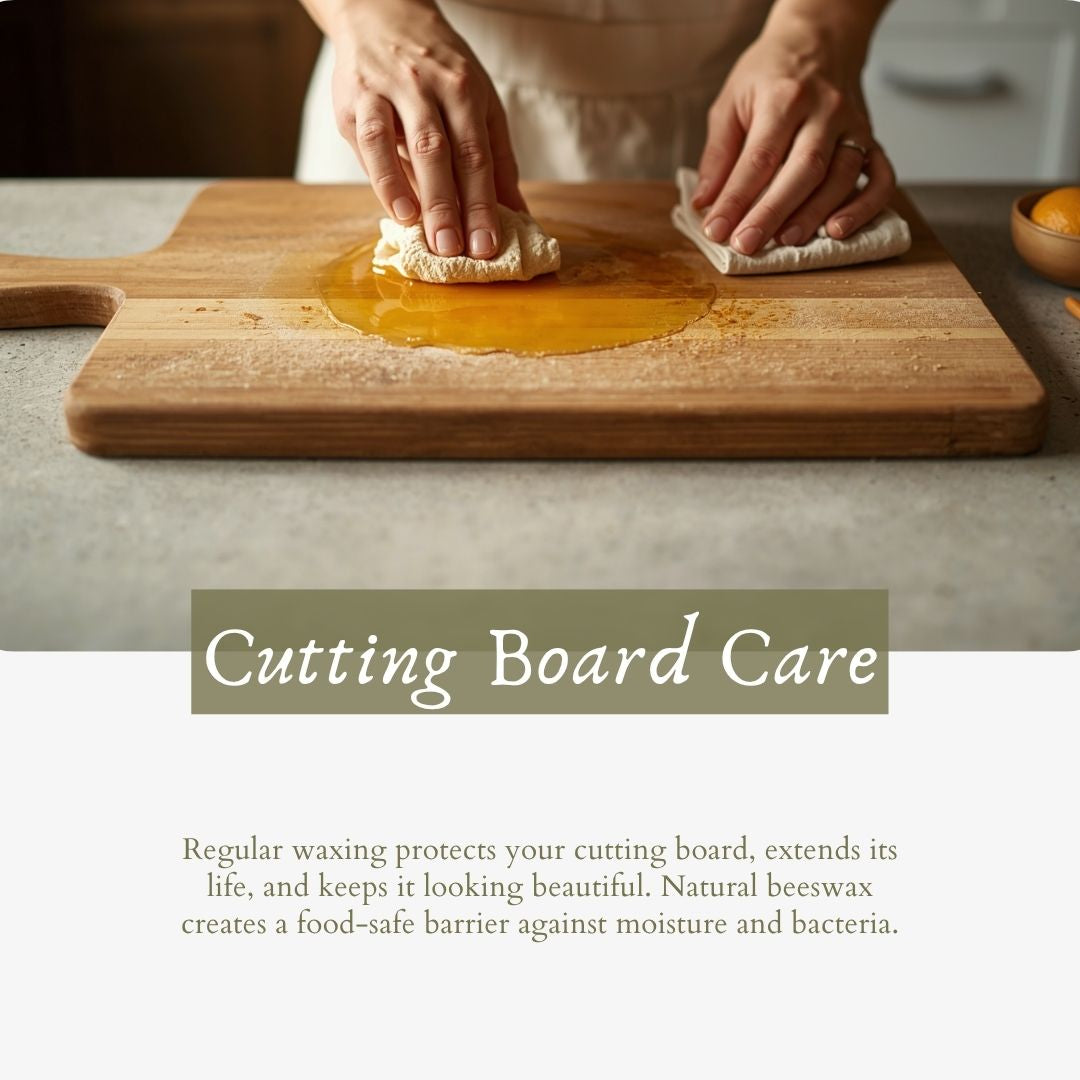
After oiling, applying a food-safe wax or board cream adds a second layer of protection that seals in the oil, repels water, and gives the board a beautiful, low-sheen finish.

The best wax products for cutting boards are board creams made from beeswax and food-grade mineral oil. For the oiling step, food-grade camellia oil is an outstanding choice — prized in Japanese kitchen culture for its stability and gentle conditioning properties on both wood and steel.

Derived from the camellia plant, this food-grade oil has been trusted in Japanese kitchens for centuries to protect and condition both steel blades and wood surfaces. Highly stable, virtually odourless, and completely safe for food-contact surfaces.
1. Always oil the board first and allow it to fully absorb before applying wax.
2. Apply a small amount of board cream or beeswax to the surface using a soft cloth.
3. Work the wax into the surface using small circular motions, covering all faces and edges.
4. Leave to sit for 20–30 minutes to allow the wax to harden slightly.
5. Buff to a smooth finish with a clean dry cloth.
Wax your board every 1–3 months depending on frequency of use — or any time the surface begins to look dull and water stops beading.
Wooden cutting boards have natural antibacterial properties — bacteria drawn into the wood's grain tend to die off rather than multiply. However, proper sanitising after handling raw meat, poultry, or fish is still essential.
White vinegar: Spray or wipe undiluted white vinegar over the board surface and leave for a few minutes before rinsing.
Salt and lemon scrub: Scatter coarse salt over the board, use a halved lemon to scrub the surface. Rinse with cool water and dry immediately.
3% hydrogen peroxide: Apply with a cloth, leave for a few minutes, then rinse thoroughly.
Undiluted bleach will dry out, discolour, and damage the wood's surface. If bleach must be used, dilute heavily — no more than 1 tablespoon per gallon of water — rinse thoroughly, dry immediately, and re-oil once dry.
A solid wood board — cut from a single continuous plank — is the most demanding cutting board to maintain. It has all its grain running in one direction, making it more reactive to changes in moisture and temperature.
In homes where heating reduces indoor humidity in winter, solid wood boards may need more frequent conditioning — perhaps every two weeks. A well-conditioned board will have a warm, rich tone. A drying board will appear pale, chalky, or grey.
When a board develops deep cuts and rough patches, it can be fully restored: sand the surface progressively with 80-grit, then 120-grit, then 220-grit sandpaper, always working with the grain. After sanding, remove all dust, dry completely, then oil 3–4 times as if it were new.
Feel the surface. It should feel smooth, slightly silky, and cool. If it feels rough, dry, or gritty — or if the wood appears pale or grey — it is time to oil immediately.
The wood is drying out and needs oiling immediately. Apply mineral oil generously to all surfaces and repeat 2–3 times over the next 24 hours.
The wood grain has opened from moisture or drying. Lightly sand with 220-grit paper along the grain, remove dust, then oil fully.
Caused by uneven moisture absorption. Oil all surfaces including the underside and edges, stand upright to dry evenly.
The board has dried out severely. Oil immediately and repeatedly. Deep splits through the board usually indicate replacement is needed.
Scrub with coarse salt and lemon, then rinse and dry. If mould penetrates deeply, sand back to clean wood, sanitise, dry, and re-oil.
Food odours have been absorbed into the wood. Use the coarse salt and lemon scrub method, then rinse, dry, and oil. Repeat as needed.
Use this schedule as a guide for solid wood and composite wood boards. Synthetic boards require only the after-use step.
| Frequency | Task | Notes |
|---|---|---|
| After every use | Wash with cool water and mild soap. Dry immediately. Stand upright to air-dry both sides. | Never soak. Never dishwasher. |
| As needed | Salt and lemon scrub to remove food odours and surface stains. | Especially after garlic, fish, and raw meat. |
| Every 3–4 weeks | Apply food-grade mineral oil to all surfaces. Repeat 2–3 times if board looks dry. | More frequent in dry climates or winter heating. |
| Every 1–3 months | Apply board cream or beeswax to all surfaces. Buff to finish. | Always oil before waxing. |
| Every 6–12 months | Inspect for cracks, staining, and deep cuts. Sand if needed (80 → 120 → 220 grit). | Re-oil and wax after sanding as if new. |
| Before first use | Oil new boards 3–5 times before use, with several hours between each application. | Critical for solid wood boards — do not skip. |
Hand wash with cool water · Never dishwasher · Never soak · Dry both sides immediately · Oil every 3–4 weeks with food-grade mineral oil · Wax every 1–3 months · Treat solid wood boards on all six surfaces equally · Sand and restore when needed
Browse our selection of top-quality Combekk cutting boards — precision-crafted in Holland, exceptionally durable, and built for serious kitchen use.
A well-cared-for cutting board rewards you with years — even decades — of beautiful, safe, and reliable kitchen service.

Written by Online Support


Leave a comment
This site is protected by hCaptcha and the hCaptcha Privacy Policy and Terms of Service apply.