
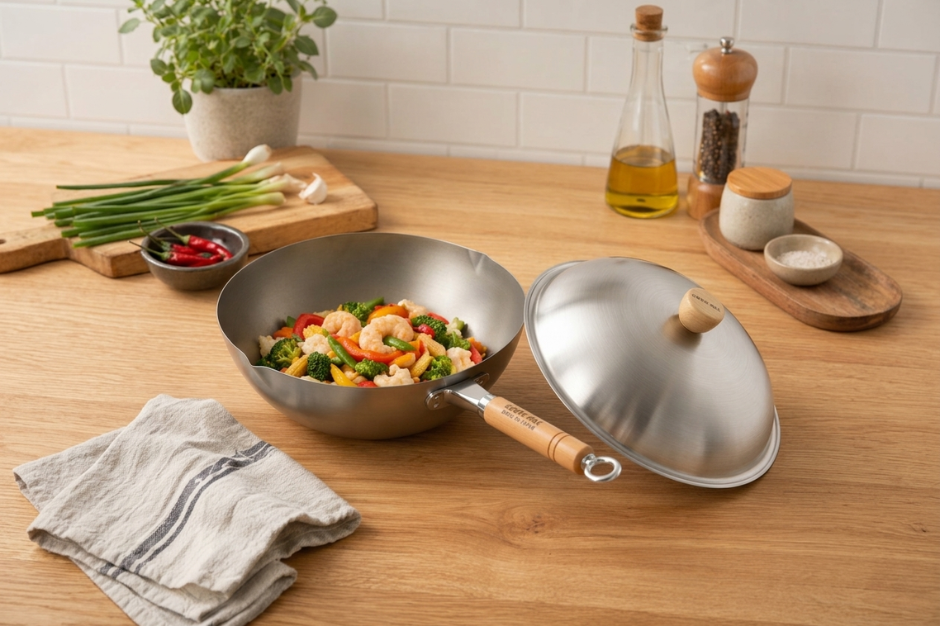
The Yoshikawa Titanium Wok: A Complete Buyer's Guide to Japan's Lightest, Purest Cookware
The Yoshikawa Titanium Wok is crafted from pure titanium — one of the most biocompatible and chemically inert metals known. It is a true lifetime cookware piece: feather-light, rust-proof, and entirely free of synthetic coatings. This guide explains its strengths, its trade-offs, and what to expect during everyday use.
- Exceptionally lightweight — often a quarter of cast iron's weight, making tossing and stir-frying effortless
- Heats up very quickly, ideal for high-heat stir-frying
- Completely rust-proof and corrosion-resistant
- Pure titanium — no coating to chip, peel, or wear out
- Biocompatible and hypoallergenic, safe even for those with nickel sensitivity
- Does not react with acidic foods (tomatoes, vinegar, citrus, wine)
- Imparts no metallic taste to food
- Extremely durable — won't warp, dent, or break under normal use
- A true lifetime pan with minimal maintenance
- Not non-stick — requires proper preheating and oil technique
- Lower heat retention than cast iron (cools faster when food is added)
- Lower thermal conductivity — can develop hot spots
- Higher price point than carbon steel or stainless steel
- Does not build a true seasoning layer like carbon steel
- Surface will naturally discolor with use (cosmetic only)
- Best results require slight technique adjustment from cast iron users
Yes — completely. Yoshikawa titanium woks are made from pure titanium with absolutely no coatings of any kind.
There is no PFOA, no PFAS, no PTFE, no Teflon. There is no aluminum, lead, cadmium, or nickel that could leach into food. Titanium is the same material used in medical and dental implants — it is considered one of the safest, most biocompatible metals in existence.
Because titanium is chemically inert, it will not react with acidic ingredients like tomatoes, citrus, vinegar, or wine, and it will not impart any metallic taste to your dishes.
Set expectations clearly: this is a bare-metal wok, not a non-stick pan. It behaves more like carbon steel or stainless steel than a coated pan.
With proper technique — preheat the dry wok until hot, add oil, then add food (the classic Chinese principle of "hot wok, cold oil") — food releases cleanly. This is intentional: the absence of a coating is exactly what makes the wok chemical-free and gives it a lifetime lifespan.
Your titanium wok will change color with use. This is completely normal and is not a defect.
What you will see: a rainbow sheen of gold, bronze, blue, purple, and sometimes green appearing on the cooking surface after the first few uses. Over time, the colors deepen and the surface can take on a darker, mottled, or patchy appearance.
Why it happens: When titanium is heated, it forms a thin titanium oxide layer on its surface. The thickness of that oxide layer determines the color you see — this is the same physics that creates the colors of anodized titanium jewelry.
Discoloration does not affect cooking performance, food safety, taste, or the wok's lifespan. It is a natural property of the metal — it cannot be fully prevented, because it's caused by the same heat that lets the wok cook.
To reduce or clean it: a paste of baking soda and vinegar, or Bar Keepers Friend with a non-abrasive pad, will lighten most discoloration — but it will return with use. Most experienced cooks come to see it as the mark of a well-loved pan.
Heat retention (thermal mass). Cast iron is heavy and dense — a 30cm cast iron wok can weigh 2.5–3.5 kg, while a Yoshikawa titanium wok of the same size weighs just 700–900g. Heat retention depends on the mass of the metal.
Thermal conductivity. Titanium also conducts heat more slowly than carbon steel or cast iron. So once a cold spot forms where food was added, it takes longer to recover.
The very properties that make titanium light, rust-proof, and chemical-free are what make it a poor heat reservoir. Titanium is built for agility and purity; cast iron is built for thermal mass.
How to get the best results:

Written by Online Support



Leave a comment
This site is protected by hCaptcha and the hCaptcha Privacy Policy and Terms of Service apply.