
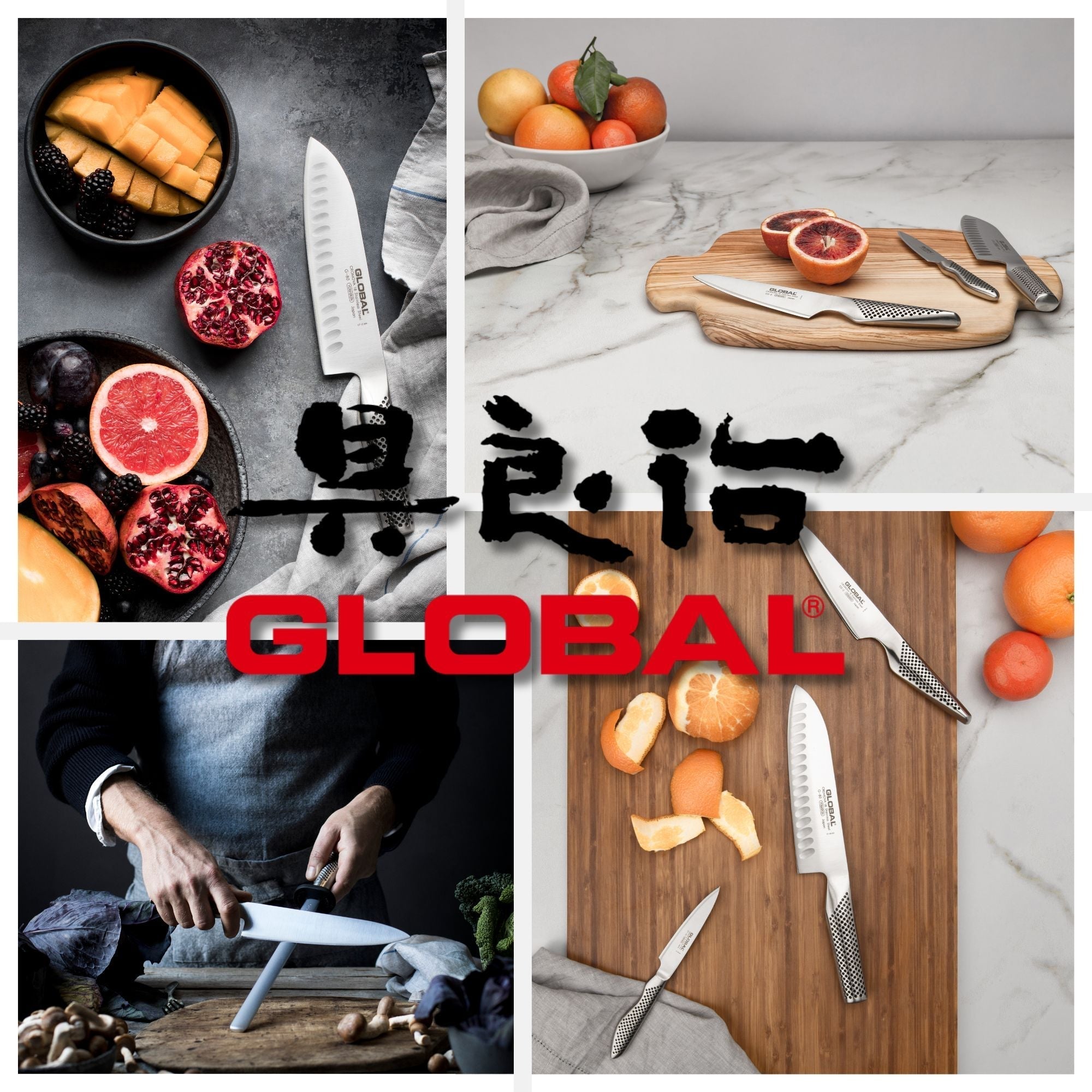
Decoding Global Knives: G, GS, GF & GSF Explained
G vs GS vs GF vs GSF
If you've ever browsed Global's lineup, you've seen the shorthand: G‑2, GS‑5, GF‑33, GSF‑15. To the uninitiated it looks like a parts catalog. To anyone who's spent time behind a Japanese knife, those two‑letter prefixes tell you almost everything you need to know — size, weight, and intended use — before you ever pick the knife up.
Global, made in Niigata by Yoshikin, has been producing its iconic seamless stainless knives since 1985. Every blade in every collection is forged from the company's proprietary CROMOVA 18 stainless steel and finished with the unmistakable dimpled handle filled with sand for balance. What changes between collections is the geometry: how big the knife is, how heavy it feels, and where the weight lives in your hand.
The steel is the constant. The shape is the variable. Pick the shape that matches the way you cook.
The G series is the flagship. When most people picture a Global, they're picturing a G‑2 — the 8‑inch chef's knife that put the brand on professional kitchen counters around the world. Full‑size blades, seamless one‑piece construction, and that famously light, nimble feel that made Global the antidote to heavy German knives.
Best for: everyday cooks and pros who want a fast, agile primary chef's knife or santoku. If you're buying your first Global, start here.
Iconic models: G‑2 (8" Chef's), G‑46 (7" Santoku), G‑5 (Vegetable).
If the G series is your main knife, the GS series is what lives next to it. These are compact blades — paring knives, small utilities, petty knives — built for the close‑in tasks where a full‑size chef's knife is overkill: peeling shallots, supremeing citrus, deveining shrimp, trimming herbs.
Best for: a dedicated companion to a G‑series chef's knife, or for cooks with smaller hands who find full‑size blades cumbersome.
Iconic models: GS‑38 (3" Paring), GS‑5 (Vegetable), GS‑89 (5.5" Utility).
The GF series is Global's answer to cooks raised on German knives who want Japanese steel without giving up the heft. These blades carry a thicker spine and a pronounced weighted bolster at the heel, shifting the balance forward and giving each cut more authority. Same CROMOVA 18 edge, but a fundamentally different feel in the hand.
Best for: heavy prep — breaking down poultry, splitting winter squash, working through dense vegetables — or cooks who prefer the reassurance of weight behind the blade.
Iconic models: GF‑33 (8" Heavyweight Chef's), GF‑34 (10" Chef's).
Last of the four: the GSF series. Think of it as the GS philosophy — small, close‑work blades — built with the bolstered, weighted construction of the GF line. The result is a compact knife that still feels substantial, with reassuring heft for precision work.
Best for: cooks who like the GF feel and want it carried through their smaller knives too — paring, petty, and small utility work.
Iconic models: GSF‑15 (3" Paring), GSF‑22 (4.5" Utility).
| Series | Size | Weight / Feel | Best Role |
|---|---|---|---|
| G | Full‑size | Light, agile | Primary chef's / santoku |
| GS | Small / compact | Light | Paring & finishing companion |
| GF | Full‑size | Heavy, bolstered | Heavy prep, German‑style feel |
| GSF | Small / compact | Heavy, bolstered | Weighted small‑task knife |
If you're building a Global kitchen from scratch, a sensible path looks like this:
One knife to start: a G‑series chef's knife or santoku — almost always a G‑2 or G‑46. It will handle 90% of what you do and will introduce you to the line's signature handling.
Two knives: add a GS‑series paring knife (the GS‑38 is the workhorse). Now you have full‑size for big cuts and small‑and‑nimble for detail.
If you prefer heft: swap the G chef's for a GF‑33. Same steel, same brand, but with the weight forward of your hand. Pair with a GSF paring if you want the heavier feel throughout.
The pro setup: G chef's, G santoku, GS paring, plus a GF for the heavy stuff and a bread knife. That's a quiver that handles essentially any home or line‑cook task.
❖ ❖ ❖The beauty of Global is that the four collections aren't competing — they're complementary. Same Niigata steelwork, same iconic look, but four different answers to the question of how a knife should feel in your hand. Once you can read the codes, the catalog stops looking like a parts list and starts looking like a thoughtfully curated set of choices.
Whether you're after the agile classic, a precise companion, a weighted workhorse, or a substantial small blade, there's a Global built for it.
Browse the full Global Knives collection at JapanChefKnife.com — G, GS, GF, and GSF series, all in one place, with expert guidance and authentic Japanese craftsmanship shipped worldwide.

Written by Online Support


Leave a comment
This site is protected by hCaptcha and the hCaptcha Privacy Policy and Terms of Service apply.